
Rectourethral fistula, a complication after surgery for rectal cancer. Restoration with the York-Mason method.
History
A patient underwent surgery on 6/2021 for rectal cancer (at a distance of 10 cm from the sphincter) in a private clinic. A rectosigmoidectomy was performed with an end colostomy and a 5 cm long rectal stump.
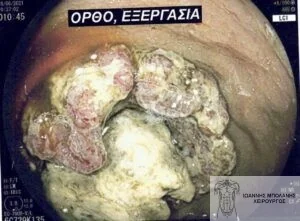
On 5/2022, he developed a hernia despite the stoma and underwent a new operation in a public hospital for hernia repair and colon reattachment, with a simultaneous protective, temporary ileostomy. A few days after the operation, the patient experienced urine discharge from the anus. From the control it was established the creation of an rectourethral fistula.
The patient underwent a third operation, during which the fistula was excised and the bladder and bowel were sutured. Despite all this, leakage of urine from the anus and fecal contents during urination continued.
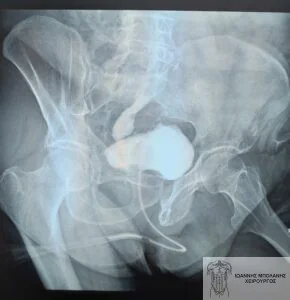
A fourth operation followed, with a final colostomy again, closure of the temporary ileostomy and additional suturing of the bladder. However, the rectourethral fistula recurred. The patient underwent two more transanal sutures to repair the fistula, without success. In total, he had undergone six surgeries.
Intervention
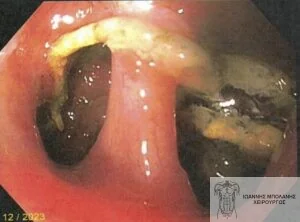
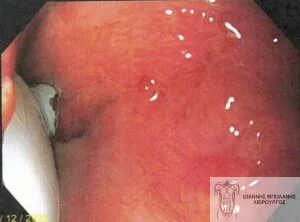
The patient came to my office on 12/2023 for further treatment. From the control carried out (orthoscopy, magnetic), a wide communication between the rectum and the bladder was revealed, with the presence of non-absorbable sutures.
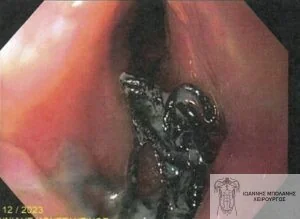
It was decided to perform a York-Mason posterior transrectal transanal approach, which offers the best possible visual exposure of the fistula without requiring access to the abdomen.
The patient was placed in a prone "Jack-Knife" position.
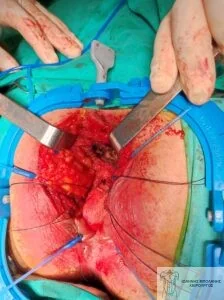
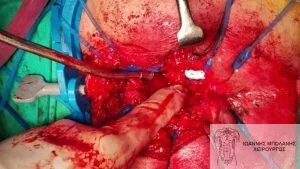
An incision was made in the midline of the anus and sphincter. The ends of the muscles of the anus (internal, external sphincter, and puborectalis) were identified and marked with absorbable sutures for later repair. This was followed by opening the posterior wall of the rectum and removing the terminal end of the coccyx for better exposure, due to the large size of the fistula, ensuring direct visual access.
The fistula was resected and the bladder and anterior rectal wall sutured in layers, as well as posterior rectal wall and sphincter repair.
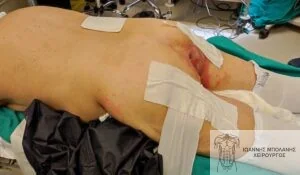
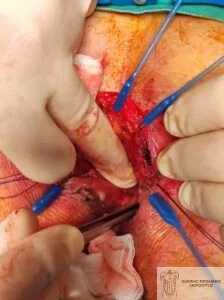
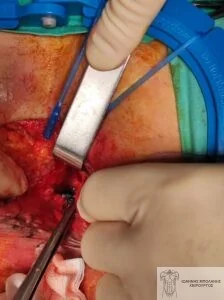
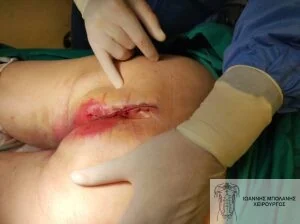
The postoperative course was uneventful. The patient was discharged on the second postoperative day with a bladder catheter, which was retained for one month.
Conclusion
After one month, cystography was performed to check for possible leakage. No active fistula was found and the catheter was removed. Since then, there is no leakage of urine from the anus.
The patient remains with the colostomy, as he does not wish further surgical interventions for restoration, fearing new complications or suffering, as he also suffers from other co-morbidities.
The treatment of complex and complex fistulas between intestine and cyst or bay it is extremely difficult and requires a lot of experience and knowledge of techniques. However, it is possible to a large extent when we turn to specialized surgeons.