
Faecal incontinence due to sphincter injury new surgical repair techniques
Faecal incontinence due to sphincter damage, there are sphincter surgical repair techniques with excellent results and improved quality of life. The modern rehabilitation operations we apply reconstruct all the muscles in the area and there is no need for a temporary colostomy.
Medical advice should be sought as early as possible (<6 months) to achieve the best possible results in sphincter injuries. Immediate intervention by a specialist surgeon can achieve complete recovery.
Even in neglected cases (>6 months) where a long time has passed since the injury the improvement is very significant after a proper operation. Unnecessary interventions in the area by non-specialists should not be made as they worsen the final result.
Faecal Incontinence
Fecal incontinence is a taboo condition, but not as rare as we think. The true frequency of the problem is underestimated as most patients do not seek medical attention but hide their problem.
Faecal incontinence is more common in women and is usually due to natural childbirth (birth injury) and weakening of the sphincter with age. Incontinence can be mild only in gas to heavy and solid stools.
Of course there are other causes of faecal incontinence such as operations in the area, for example perineal fistulas, abscesses, tumors, hemorrhoids etc. Or neurological diseases. All this makes up a difficult problem, for the solution of which a special approach is needed. The diagnostic and therapeutic approach to the problem includes:
- Specialized tests ultrasound of the sphincter (endoscopic ultrasound), manometry, faecesogram (simple or with magnetic resonance imaging)
- But also conservative treatments, special diet, biofeedback, drugs
- And/or surgical operations, restoration of the sphincter, correction of prolapse or rectal hernia, sphincter swelling techniques, natural or artificial neosphincter, etc.
Clamp Failure
Sphincter injury is more common in women and is usually due to normal delivery and perineotomy. Less commonly, they are the result of operations for hemorrhoids, anal fissures, or anal fistulas. Injuries of the sphincter must be diagnosed immediately and treated only by specialized colon-anal surgeons and after a special full check-up. The special tests that are needed, in addition to the clinical examination and proctoscopy, are magnetic resonance imaging or endoscopic ultrasound of the area and, depending on the case, manometry, faeces, bowel transit time, etc.
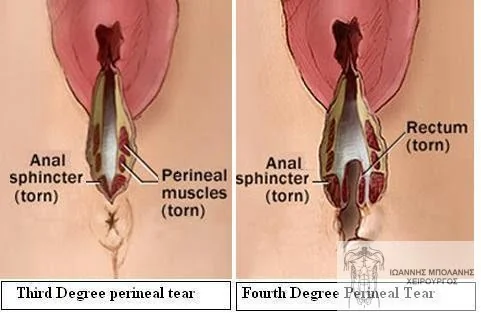
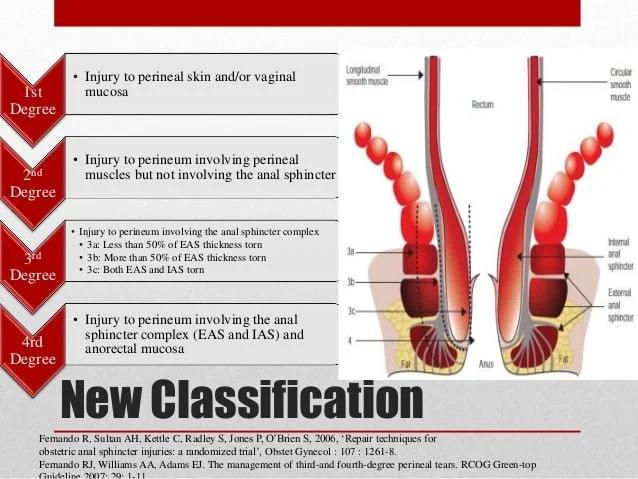
Grades of Perineal Tear
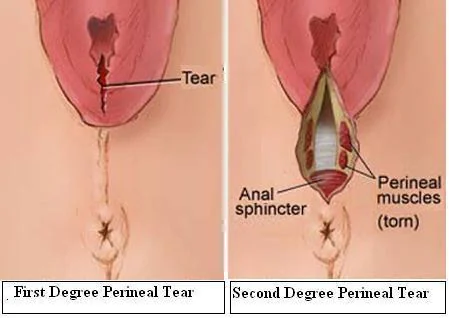
- 1st Degree: Injury to the skin of the perineum and/or vagina
- 2nd Degree: Perineal muscle injury without the sphincter
- 3rd Degree: Injury to perineum and sphincter muscles
- 4th Degree: Injury to the perineum, sphincter and rectal muscles
As expected, the 3rd And 4th Degree ruptures present both the greatest incontinence problems and the greatest difficulty in recovery.
4th Degree sphincter injury in a postpartum woman
A 28-year-old female patient with fecal incontinence due to perineal incision after childbirth. This is a 4th Degree rupture (total, this is the heaviest form) which was established 1-2 months after delivery and the patient had complete fecal incontinence. The vagina has been united with the anus. The sphincter injury was repaired within 6 months. Restoration of the anatomy of the perineum included:
- Bay suture
- Stapling of the rectal mucosa
- Suture muscle elevators
- Internal clamp suture
- Staple out clamp
- Suture of transversus perineus muscle
- Perineal skin suturing
4 Years later, the patient does not have any incontinence problems and has had two more cesarean deliveries.
Complete section of 3rd Degree sphincter after normal delivery
A 40-year-old female patient with moderate to severe fecal incontinence due to a complete transection of the sphincter 3 years ago due to normal delivery. At the beginning of the video, the anus can be seen remaining open as the sphincter has been completely severed. The perineum and sphincter muscles were repaired with absorbable sutures.
Repair of the sphincter must be done as soon as possible after the injury because otherwise the muscle atrophies due to inactivity. Although the patient lives abroad and had visited a special center for these cases, her problem had not been properly diagnosed for two years, resulting in a delay in her recovery. Immediately after the operation, the incontinence had already started to improve, while at 6 months the improvement was spectacular and continues.
6 Months after the surgery, the patient shows a spectacular improvement in the control of bowel movements.
Check them out video.