
Laparoscopic Colectomy – Robotic Colectomy
Laparoscopic Surgery for Colon Cancer
The role of laparoscopic and conventional surgery in the treatment of colon cancer is one of the most debated issues, and now robotic surgery is being added.
Reading what is written on the Internet and in the media, I believe that a confusion is created for the patient reader who tries to understand what is best for him classical, laparoscopic or robotic.
There is a simple but important rule when it comes to cancer, because mistakes are unforgivable in oncology, choosing the right surgeon is of the utmost importance. Practically, this means that it is infinitely more important that the surgeon is specialized in the intestine than whether it will be done laparoscopically or classically. It has now been proven that they are equivalent as long as they are done correctly and with the correct indications. It is not uncommon to see patients operated laparoscopically by an inexperienced surgeon not having a proper lymph node dissection or dispersal of the tumor due to the air being pumped into the abdomen.
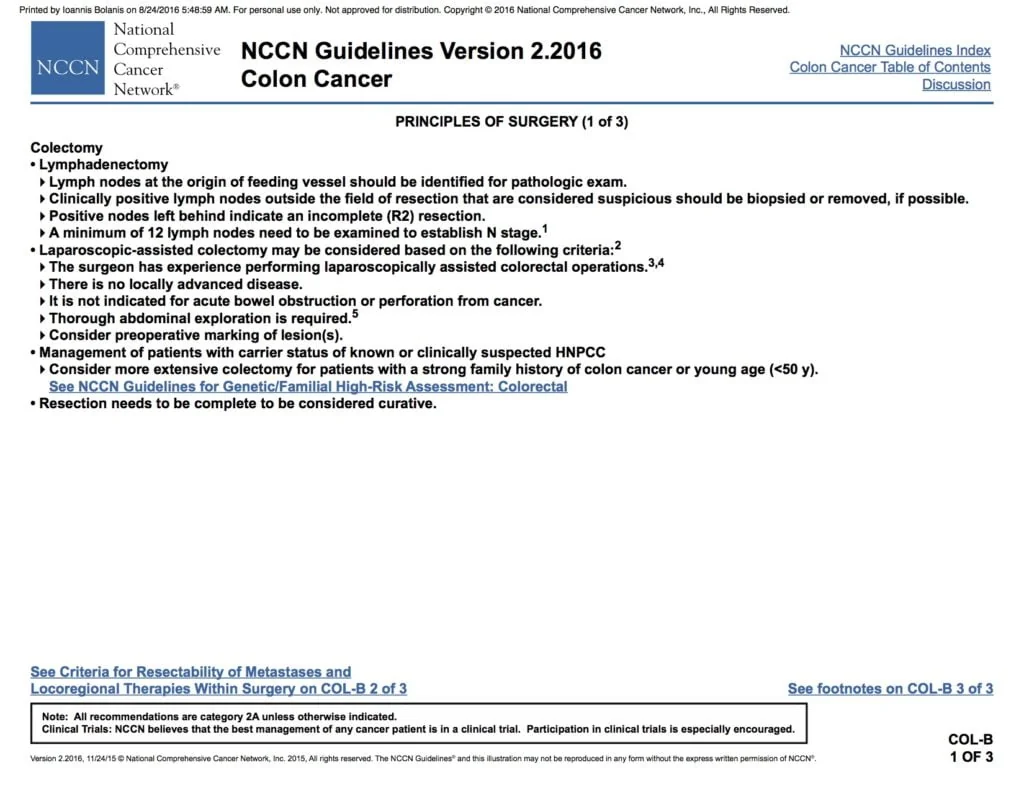
Laparoscopic is equivalent to classical in terms of relatively small tumors that do not exit the bowel wall, do not cause obstruction or perforation and without extensive lymph node spread and in these cases offer a better aesthetic result, less chance of hernia in the future and a slightly more painless and quick recovery.
In large tumors with extensive infiltration of the bowel wall or adjacent organs that must be removed together with the tumor and with multiple lymph node metastases, laparoscopic surgery should be avoided as it carries a high risk of tumor spread throughout the abdomen. Also, laparoscopic surgery is not possible in patients who have undergone repeated abdominal surgery and have adhesions. Also, the time of laparoscopic operations is longer than the classic ones and they burden certain groups of patients more with anesthesia, such as those with serious respiratory or cardiac problems.
Laparoscopic Surgery for Rectal Cancer
All of the above applies to large intestine and its upper part Rectum but in its lower third Rectum i.e. to distance <5cm from the ring things are different as access is very difficult especially for men due to the narrow and deep pelvis. Due to the difficulty of accessing this area laparoscopically various techniques have been developed which, however, do not manage to replace classical surgery, resulting in we see patients who are operated laparoscopically and have a permanent permanent colostomy while they can avoid it with classic surgery. The international organization NCCN which issues the cancer guidelines for America and Europe suggests that laparoscopic operations be done in Rectum in the context of research and in selected low-risk cases, as their equivalence with classic surgery has not yet been confirmed (see also recent studies study 1, study 2).
Robotic surgery for colon and rectal cancer
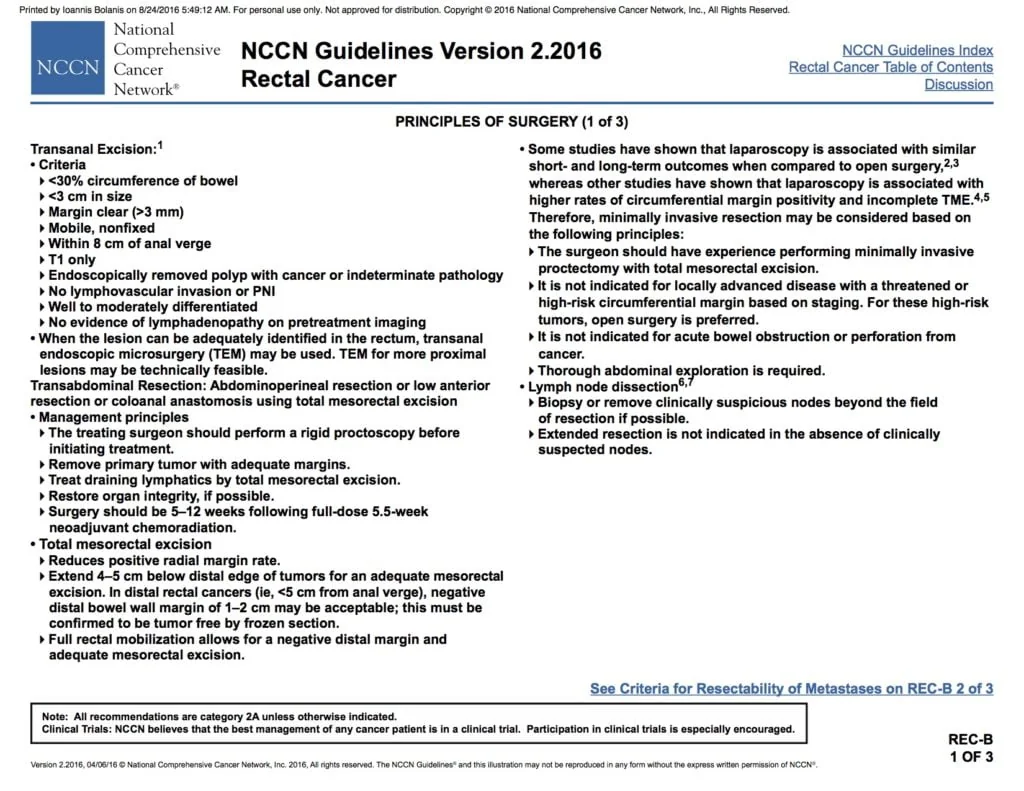
All of the above also applies to robotic surgery, which is essentially an evolution of laparoscopic surgery. The main differences are that robotic operations are more time-consuming and expensive than laparoscopic ones, but they are advantageous in some cases where greater agility is needed (e.g. Prostate surgery). The majority of the international surgical community does not consider robotic bowel surgery to have any advantage. At the moment, as shown in the images above, it is not mentioned in the international guidelines because it has not yet been officially approved as the studies on robotic colectomy continue.
3D image
Agility
Rest for the doctor
Disadvantages :
Voluminous
Expensive
No sensibility (tactile sense)
Its scope is limited to one area (eg lower abdomen)
In the event of a complication, valuable time is lost to be removed from the patient.
Machine complexity
It is also worth commenting that the use of the robot does not make a surgeon better, it is the good surgeon that makes the difference and not the machine that just follows the orders.
Conclusions for Laparoscopic colectomy – Robotic colectomy
Laparoscopic and robotic surgery, although they have benefits and specific indications, cannot replace classical surgery, which is the gold standard in the treatment of all cases of bowel and rectal cancer, culminating in difficult and advanced cases that cannot be treated laparoscopically or robotically. Classic surgery therefore remains the best option for malignant bowel tumors in the majority of cases and especially in difficult cases such as those near the sphincter. Laparoscopic surgery is preferred in benign diseases and small tumors that do not pose a risk of spread. And robotic surgery is still under study, however, it could be used everywhere and laparoscopic since it is a variant of it.