
Perianal Fistula: Modern Laser Treatment without Damage to the Sphincter
The now modern and bloodless treatment for the Perianal fistula is carried out using a new generation laser and a special flexible optical fiber FiLaC (Fistula-tract laser closure). This technique offers effective treatment of perineal fistula without causing injury to the anal sphincter, which reduces the risk of incontinence.
A perianal fistula usually develops as a complication of a perianal abscess, an acute inflammation in the area around the anus. The abscess is the initial phase, while the fistula represents the chronic and more complicated form of the condition.
The diagnosis and treatment of periodic or anal fistula requires experience and expertise, as the anatomy of the area and the variety of fistula types (low, high, transsphincteric, suprasphincteric, etc.) make the operation demanding.
The use of laser for perianal fistulas has the advantage of rapid recovery, minimal postoperative discomfort and preservation of sphincter functionality. This makes the method ideal for patients looking for a minimally invasive solution to perianal fistula.
For more information, see Photographs and video fistula operations with laser, as well as cases of patients who were successfully treated.
Fistula Definition Diagnosis
The fistula it is a tunnel, a tunnel that joins two areas of the body that are not normally joined. So one fistula that joins the bowel to the bladder is called the enterocystic fistula, the rectum to the vagina rectovaginal fistula, while if it joins the intestine to the skin it is called an enterocutaneous fistula. The necklaces or perianal fistulas they belong to the category of enterocutaneous fistulas because they join the intestine near the anus to the skin around the anus (anal fistulas).
Perianal Fistula Causes
The mechanism of creation of the perianal fistula starts with one abscess which will be created when microbes from the gut pass through a small hole (internal orifice) into the perianal space and then when the abscess opens automatically or with surgery a new opening (external orifice) will be created. This creates a communication (fistula) between the internal and external orifice.
Other causes of perianal fistula formation
- Inflammatory bowel disease (Crohn's)
- Accidents or injuries in the anus area
- Complications from operations in the anus, e.g. For anal fissures, hemorrhoids, etc
- Radiation for local cancers (prostate, gynecological
- Inflammations of the area eg hidrotadenitis
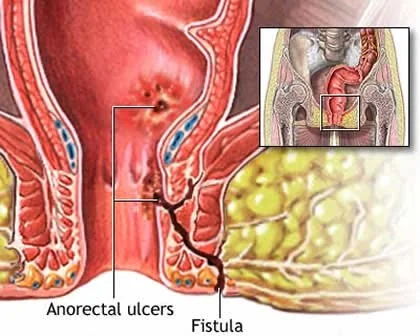
Perianal Fistula Symptoms
A perianal fistula can have minimal to significant symptoms.
- Effusion of fluid from the dermal (external) orifice.
- Itching.
- Stench.
- Pain.
- Formation of granulomatous tissue that bleeds.
- Abscess if the external orifice is blocked.
- Creation of other fistulas and expansion.
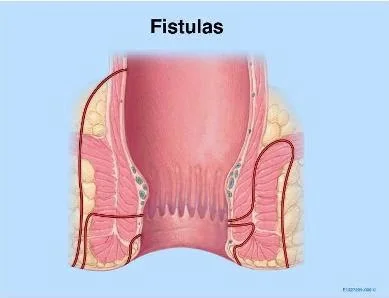
Periodic Fistula Classification
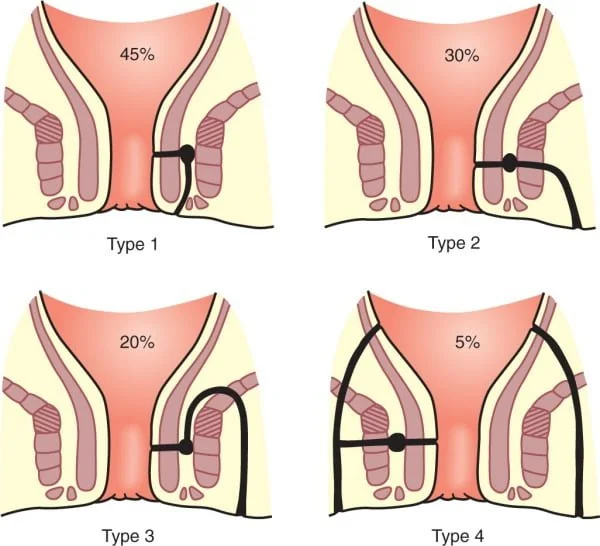
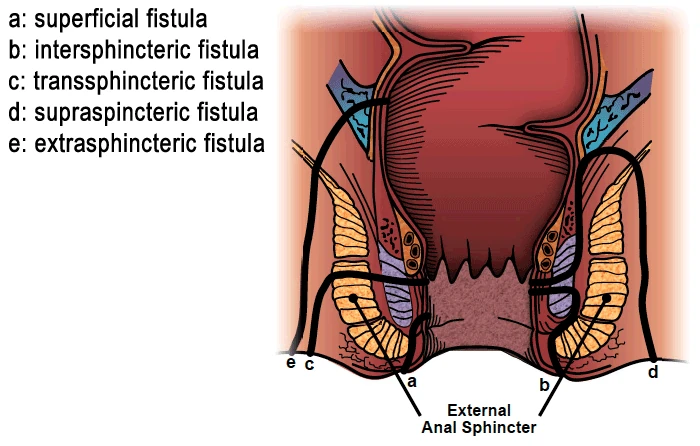
According to the spaces resulting from the anatomical arrangement, 5 types of rectal fistula are distinguished based on their relationship with the sphincter:
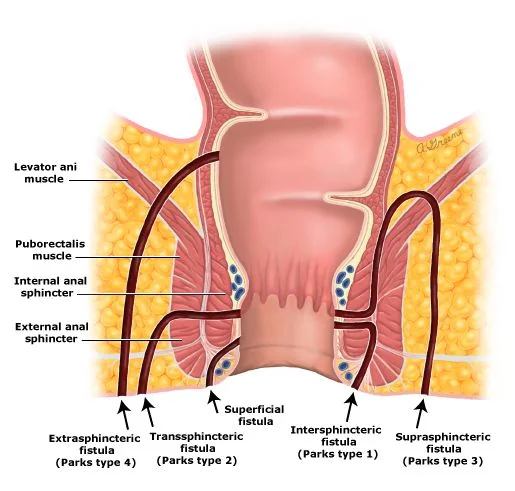
- Intersphincteric fistula (Parks type 1)
- Transsphincteric fistula (Parks type 2)
- Suprasphincteric fistula (Parks type 3)
- Extrasphincteric fistula (Parks type 4)
- Superficial fistula
They can also be simple or complex depending on whether they consist of one or more (branching) fistulas.
This distinction is important and must be made before any intervention as both the clinical picture and the treatment may differ from case to case.
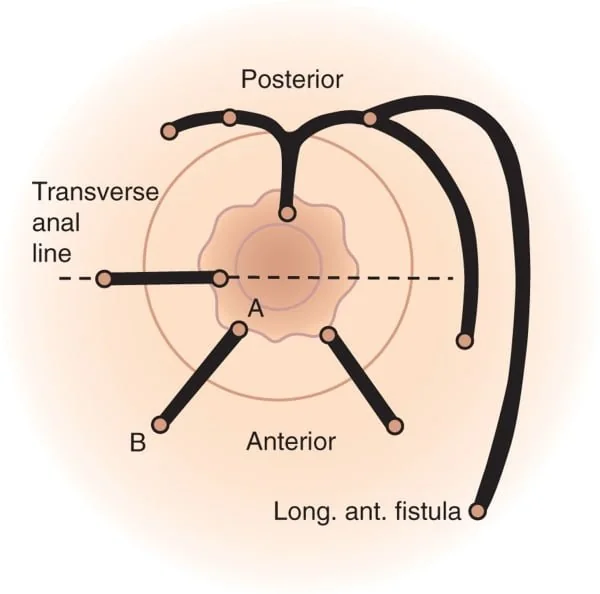
There are many surgical techniques for the treatment of fistulas, each with its pros and cons, but none achieves 100% success rates, and that is why we must inform patients that a subsequent operation may be necessary, especially in complex cases where treatment is usually performed in stages. Especially for complex fistulas, they should be operated by specialized and experienced surgeons to avoid the risk of incontinence or the need for a colostomy (abnormal seat).
The surgeon who deals with fistulas must know various surgical techniques such as seton, advancement flap, Lift, FiLaC® to be able to deal with all types and complications of fistulas and not just one method. He must also know the operation of the sphincter so as not to cause incontinence.
The diagnosis of a perianal or perianal fistula is usually not difficult, since it manifests itself as a superficial, visible hole around the anus, accompanied or not by fluid discharge and possibly systemic phenomena (fever, leukocytosis). Clinical examination reveals an area with redness, hardness, and tenderness.
Perianal Fistula Mapping
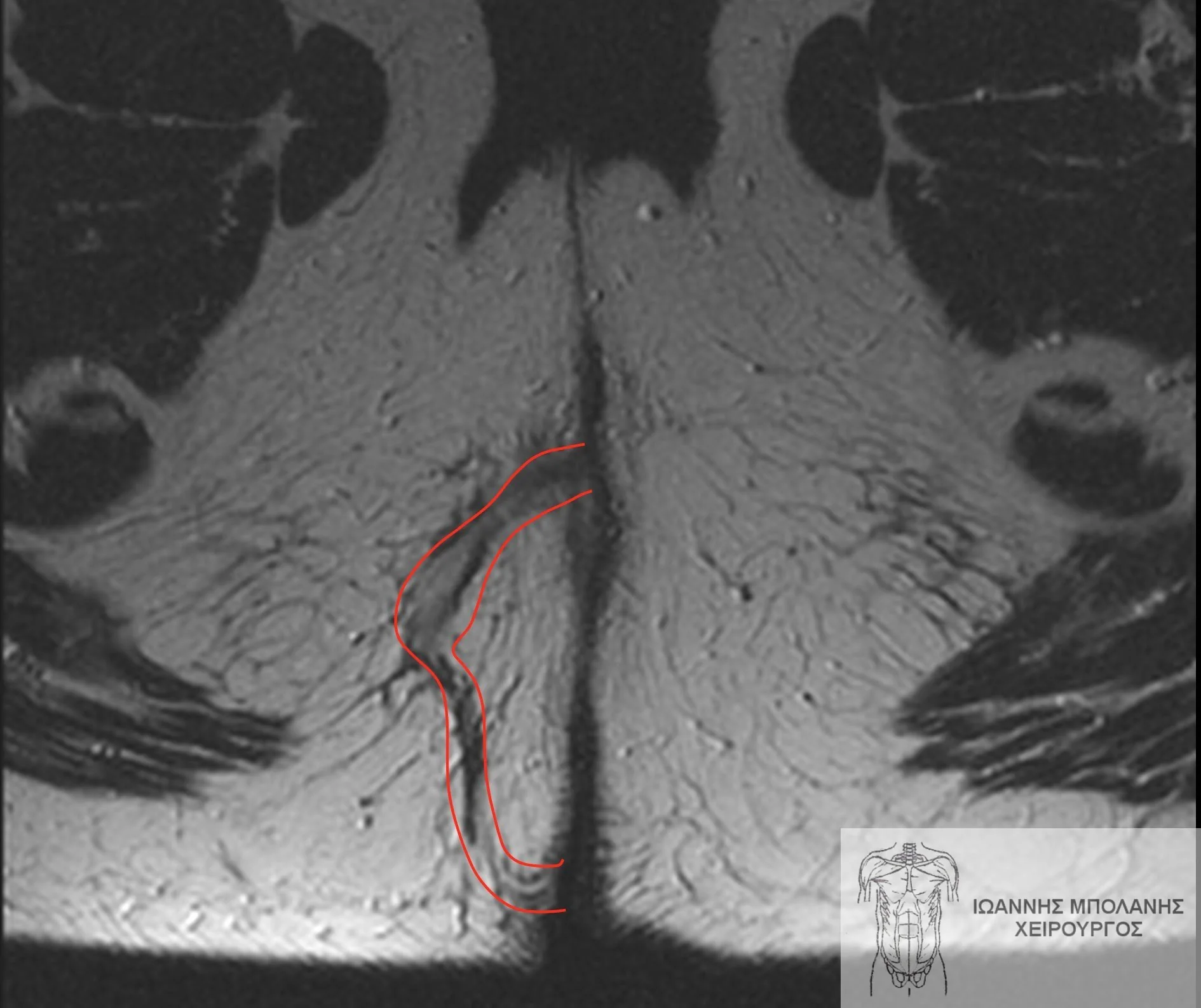
The diagnosis of fistula is clinical in most cases. However, in cases where the clinical signs are disproportionate to the symptoms, imaging methods can offer significant help. Two methods are used to image the area: Intrarectal ultrasound and magnetic resonance imaging.
These same tests are used to map and localize fistulas in the area and detect abscesses that may complicate treatment. Preoperative mapping and visualization of the fistulas is very important in complex fistulas in order to make the correct planning of the operation. It is not good to go to the operating room unprepared for the type of operation we will have to do.
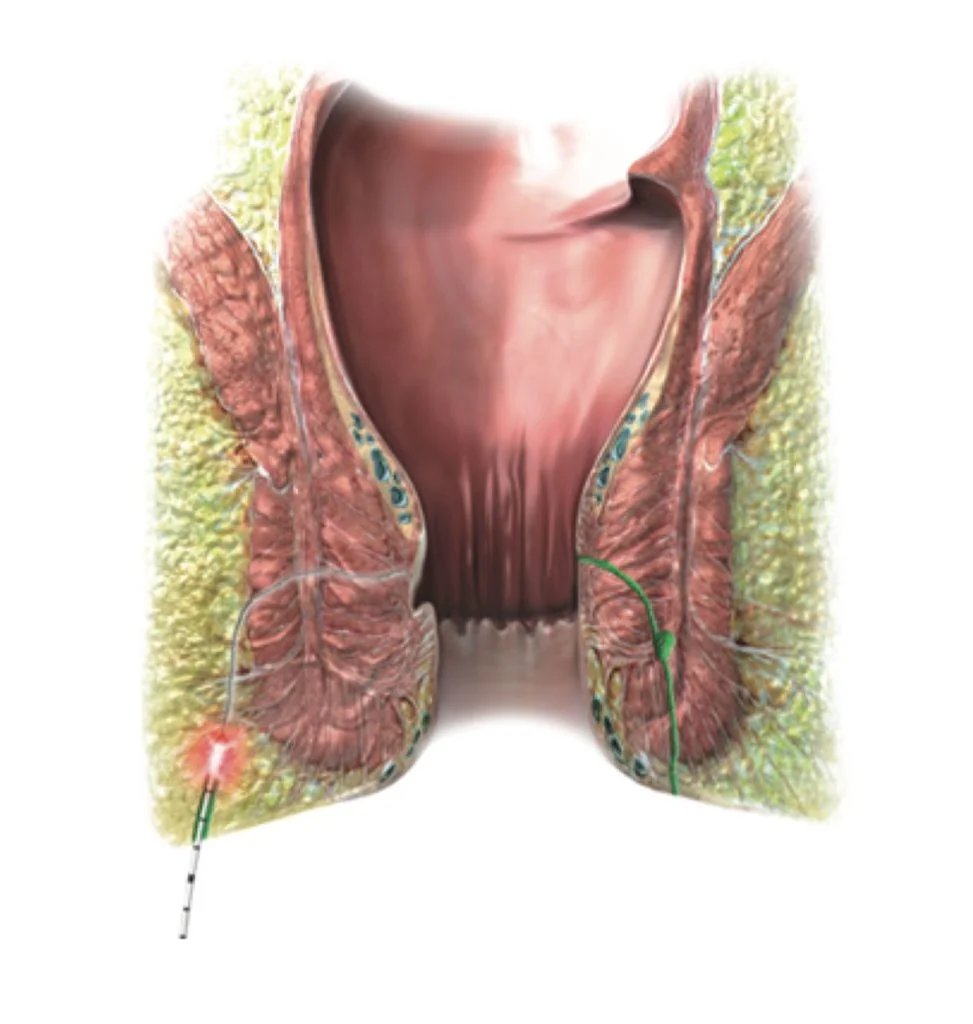
Mapping of the perianal fistula is also done during the operation with the use of dyes and a fistula probe (guide wire).
In patients with recurrent fistulas, complex fistulas, other accompanying diseases, inflammatory bowel diseases, a check with rectoscopy or colonoscopy is also needed. Especially in inflammatory bowel diseases and especially Crohn's disease, great attention is needed in the surgical treatment of fistulas and close cooperation with the patient's gastroenterologist. During the exacerbation of the disease, be careful to avoid operations that create traumatic surfaces.
Perianal Fistula Treatment
There are a number of techniques for the treatment of perianal fistulas, all of which have advantages and disadvantages. Unfortunately none offer 100% success. The actual success rates of the various operations amount to 90% when performed by experienced and specialized surgeons. Sometimes more than one operation (staged treatment) may be needed to prevent damage to the sphincter.
Care needs to be taken in choosing the surgeon who should have experience in the area and be well versed in the various techniques to offer the appropriate solution to the problem. It is also good to ask for a more detailed explanation of the operation because we often hear the phrase "I will do a laser" but this does not describe the technique as there are different types of laser and several ways to use it.
Treatment of perianal Fistula with Laser (FiLaC®) – Safe & Effective Solution
The most modern and advanced technique for the treatment of the perianal fistula is the FiLaC® (Fistula-tract Laser Closure) method. It is a minimally invasive procedure that uses a new generation laser with a flexible optical fiber and a wavelength of 1470nm, offering safe and targeted closure of the fistulous duct without injuring the sphincter.
During the operation, the thin laser probe enters the fistula and, through thermal energy, causes cauterization and gradual shrinkage of the lumen, leading to permanent closure of the lesion. The FiLaC® method is ideal for the treatment of simple as well as complex perianal fistulas, especially when combined with other techniques such as grafting or seton.
Advantages of the FiLaC® Method:
✅ Also suitable for pilonidal sinus / cyst fistulas
✅ Minimal postoperative pain
✅ Excellent aesthetic result
✅ Very high success rates (up to 95% in complex fistulas)
✅ It does not require general anesthesia or hospitalization – the operation can be done with local anesthesia and intoxication
Although the FiLaC® method is considered the most modern and safe treatment for perianal fistula, it should be used exclusively by surgeons with expertise and experience in anal fistulas. Incorrect settings or excessive laser energy may cause serious complications such as perforation, burns or the formation of new fistulas.
Read more for a laser puncture incident and its successful treatment.
In our clinic, we apply the FiLaC® method alone or in combination with advanced techniques, achieving excellent results even in cases of complex or recurrent fistulas. Our goal is definitive treatment with a single operation, reducing discomfort, cost and recovery time.
Seton and opening or removal of the fistula
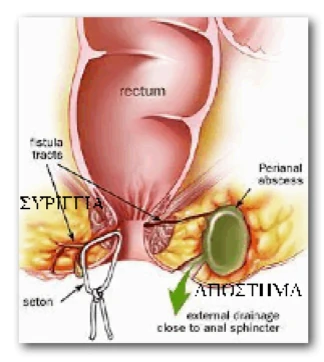
The simplest and oldest treatment of a rectal fistula is to drain it by placing a seton or to remove (or open) it when it is very superficial and does not penetrate the sphincter.
A suture is either a suture or a silicone band that is placed inside the fistula to drain it. It usually remains for several days until the fluid production from the fistula is reduced to a minimum. Because the seton's success rates are low, it is usually accompanied by a second operation. It is usually used as a first aid.
The opening or removal of the fistula is applied to simple and superficial fistulas that do not penetrate the external sphincter. It has very high success rates. The external sphincter is essential to preserve and any damage to it may cause incontinence.
LIFT Method
Another modern technique is the LIFT (ligation of intersphincteric fistula tract) applied to transsphincteric fistulas (type 2) with which we find the fistula between the external and internal sphincter and separate it, thus cutting off the communication between the internal and the external orifice (see video).
Advancement Flap (Graft) Method
In the most difficult cases it may be necessary to use intestinal mucosa as a graft advancement flap (figure 2-3). Another method with very good results is the use of a flap, i.e. a mucosa graft from the patient's intestine (Advancement Flap) with which we cover the internal entrance of the fistula (images 2-3) and which can be combined with the Lift method or the FiLaC® laser method.
A general rule in the surgical treatment of perianal fistulas is that the external sphincter should not be cut because it will cause incontinence in the patient. In complex cases we prefer treatment in stages rather than aggressive surgery that can lead to severe deformities in the area.
Other Techniques
Some other methods using biological glue, cord - plug, Ovesco clip do not have particularly good results and are rarely used.
Other types of fistulas other than ring fistulas.
Various conditions benign or malignant, inflammation, tumors, radiation or post-operative complications can create various forms of fistulas usually more serious than the more common perianal fistulas.
Rectourethral, rectovaginal, enterointestinal, enterodermal, enterocystic, etc. Are a challenge for their diagnosis and treatment.
Here we use other more complex techniques as you will see in the following examples:
✅Rectovaginal fistula restoration with graft and flap (Martius flap)
✅Low rectourethral fistula after radical prostatectomy and radiation
✅Bowel perforation repair after laser for perianal fistula.
✅Rectourethral fistula, York-Mason method.
Questions-Answers and myths about perianal fistula.
Perianal fistula surgery cost?
The price of fiber optic laser surgery is particularly affordable compared to other methods due to its high efficiency combined with very low complication rates. The price of fiber optic lasers has now come down significantly to make them more economical than other machines. Older techniques often lead to a second and third surgery, thus increasing the overall cost and suffering of the patient.
Can perianal fistula cause cancer?
The perianal abscess and the perianal fistula are benign diseases, they do not cause cancer, but they can coexist in the context of malignancy. Very rarely if the perianal fistula remains untreated for many years because of the chronic inflammation and chronic irritation of the area it can increase the predisposition to cancer.
Can a perianal fistula heal itself?
As a rule, the perianal fistula needs treatment, usually surgery, but in some cases it can heal itself or remain in an inactive form. As a rule, perianal fistulas should be operated as they can cause complications such as bleeding, infection, sepsis, incontinence and others.
The treatment of perianal fistula is difficult and requires a lot of experience. Success rates reach 80-90% with the first operation, while with the second operation they exceed 95%. The surgeon should be specialized and know the various techniques in order to apply the most appropriate one for each patient.
How long is a perianal fistula operation and hospitalization?
The duration of the operation usually ranges from 30 to 60 minutes depending on the complexity of the fistula, and hospitalization in the case of laser is usually the same day. In more difficult cases and more complex operations (technical) the duration of the operation exceeds 60 minutes and the hospitalization can reach 1-2 days.