
Rectal Cancer Without Permanent Colostomy
Today, even the lowest rectal cancers—tumors located as little as 0.5 to 1 cm from the sphincter—can avoid a permanent colostomy. This is achieved thanks to the modern technique of transsphincteric resection with pull-through anastomosis (ISR-PTDA*). * Intersphincteric resection with pull-through delayed anastomosis.
The specialized colon and rectal surgeon Dr. Ioannis Bolanis is the first to introduce and apply this technique exclusively in Greece. With the pull-through anastomosis, not only the permanent colostomy is avoided, but also the temporary ileostomy, which in the past was considered necessary. Thus, patients are freed from a second surgery and from the complications that may arise from having a stoma.
The Innovative ISR-PTDA Technique
The ISR-PTDA technique was introduced and published by Dr. Ioannis Bolani internationally in 2016, making him one of the first surgeons in the world to apply it to rectal cancer with the aim of maintaining the quality of life of patients without a permanent stoma.
| Publication | Year | Key Feature |
| Olagne et al. | 2000 | Direct delayed coloanal anastomosis post-pull-through (Turnbull) |
| Bianco & Belli et al. | 2015–2017 | Laparoscopic pull‑through delayed “high” anastomosis; no stoma, scarless |
| Bolanis et al. | 2016/17 | ISR combined with pull‑through delayed anastomosis in Greek series |
| Sage et al. | 2018 | Large series, lap delayed anastomosis without diversion stoma |
| Mukai et al. (Japan) | 2020s | ISR + pull‑through delayed anastomosis in minimal‑invasive setup |
Rectal cancer without permanent or temporary colostomy (permanent colostomy – Pouch – Ileostomy)
New innovative method avoidance of both the permanent and the temporary permanent colostomy (ileostomy or colostomy) for very low volumes of the rectum up to 1cm from the sphincter. Transsphincteric or intersphincteric resection with pull-through anastomosis which does not require a special diet or a second surgery and does not delay or burden the patient's further treatment.
The following talk in September 2018 that discusses the method of transsphincteric or intersphincteric resection of rectal cancer without colostomy and its advantages over abdominoperineal resection with permanent colostomy. As discussed in the talk (and confirmed by studies and US guidelines) permanent colostomy does not ensure better survival as thought but rather the opposite.
In general for rectal cancer.
The rectum is the last part of the large intestine before the anus. Its length is about 12-15cm and it is adjacent to the rest of the pelvic organs such as the bladder, the vas deferens and the prostate in men, the uterus and the vagina in women. The position of the rectum and the anatomy of the pelvis make it difficult and demanding to perform operations in this area. Especially in rectal cancer they should be performed by specialized colorectal surgeons.
Rectal Cancer
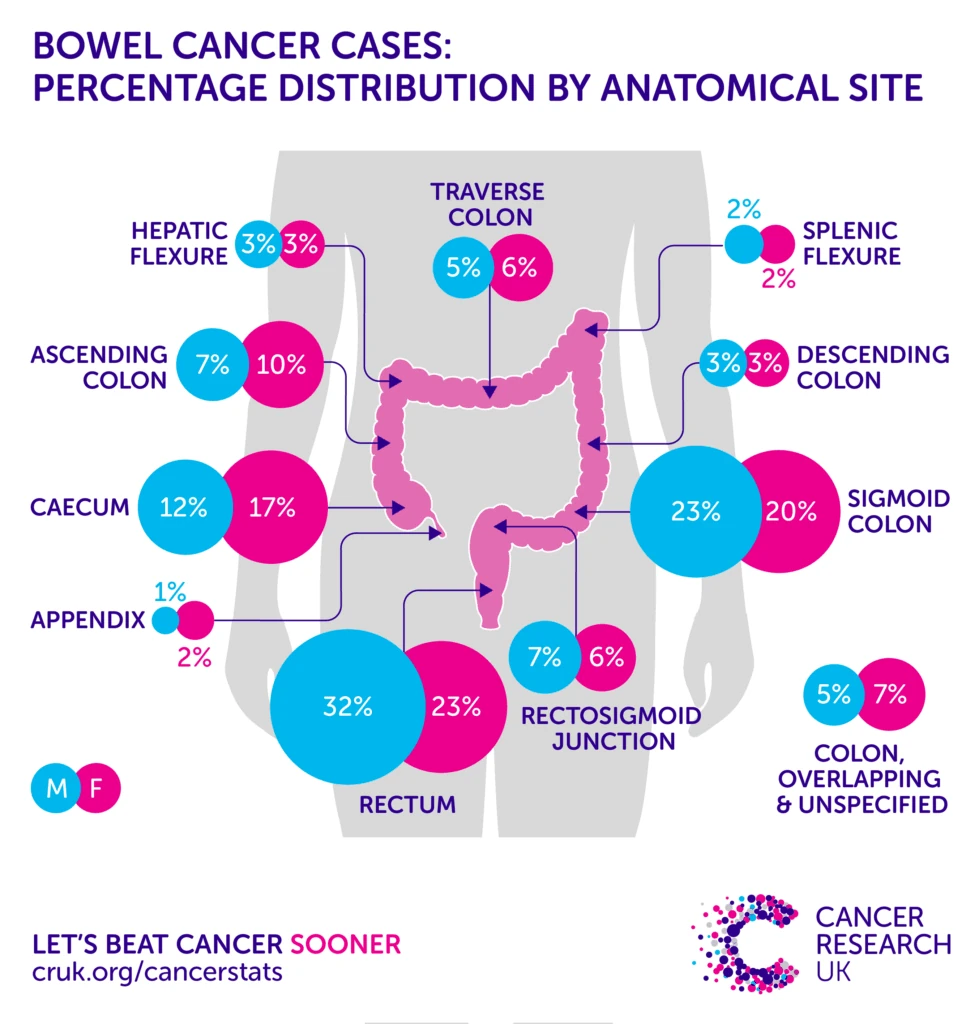
The Rectal cancer along with him colon cancer they are the 3rd most frequent malignant disease in men as well as in women. 72% of bowel cancers occur in the colon and 28% in the rectum. It usually appears after the age of 60 with the exception of hereditary forms that can develop at young ages. Therefore, it is recommended that the screening with colonoscopy starts 10 years earlier, that is, at the age of 50 years and if it is normal, to be repeated every 5 years.
50% Of bowel cancer cases are found in the rectum and sigmoid because there the feces accumulate before defecation, which contain the toxic substances we take in from food. The evolution of one polyps (benign adenoma) to cancer (malignant adenocarcinoma) occurs at a slow rate so that it takes at least 5 to 10 years for this change. Thanks to the slow progression, we have the possibility of early diagnosis with a colonoscopy every 5 years.
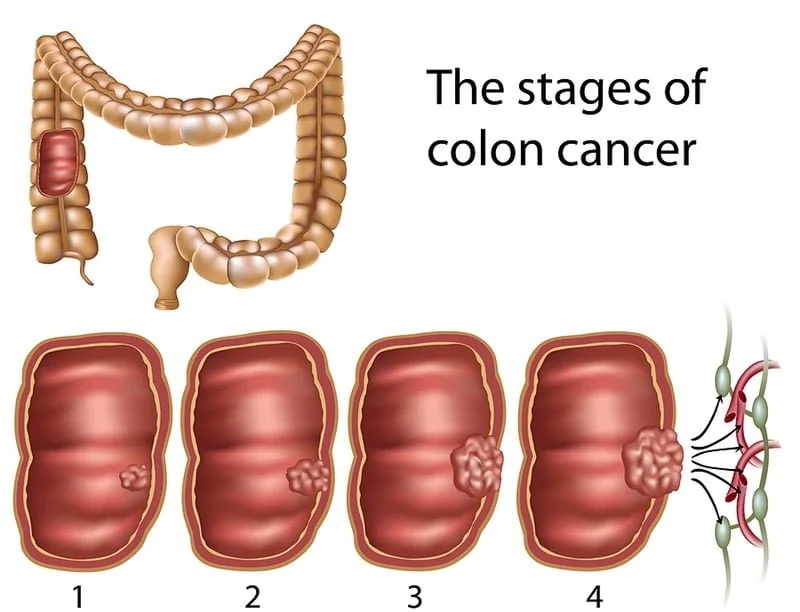
Risk factors for rectal cancer.
Risk factors that increase the likelihood of developing rectal cancer are genetic factors (familial polyposis, Lynch syndrome, chronic inflammatory diseases, relatives with a history of cancer). In these cases, relatives should be screened at least a decade earlier than the rest of the population. If, for example, a parent developed a tumor in the intestine at the age of 40, it would be good to have their children checked by the age of 3. Other risk factors are diet (foods with preservatives, red meat), alcohol, obesity and smoking.
Rectal cancer symptoms.
- Bleeding during voiding or without voiding
- Constipation that comes on gradually or suddenly
- Small thin stools
- Pain in the anus deep
- Anemia
- Feeling of incomplete emptying
- Weight loss
- Fatigue and weight loss
- Mucus in the stool
- Abdominal pain
Rectal cancer treatment.
Rectal cancer, like the rest of the bowel, has a good prognosis if treated early and correctly. The treatment and treatment of the patient with bowel cancer, as for any other type of cancer, must be coordinated by a team of specialized doctors.
Multidisciplinary Team
The multidisciplinary team usually consists of the surgeon, the oncologist, the radiotherapist, the gastroenterologist, the radiologist and the pathologist. We can achieve cure rates of over 90% in the early stages. The most important weapon in the treatment of colon and rectal cancer is radical and correct surgical cleaning, i.e. Oncological colectomy. But especially in rectal cancer due to its anatomical location, pre-operative radiation and chemotherapy treatment (neoadjuvant therapy) is often necessary.
The location of the rectum very close to the sphincter and the rest of the pelvic organs (prostate, uterus, vagina, bladder, vessels, nerves) is the main reason that has higher rates of recurrence compared to the corresponding tumors in the rest of the colon.
Radiation – Chemotherapy Before Surgery
Preoperative radiation and chemotherapy in rectal cancer should be given to tumors that infiltrate the rectal wall and extend outside the rectum or when there are enlarged lymph nodes with suspected metastases. Preoperative radiation and chemotherapy achieves:
- The shrinking of the tumor and its substaging (the stage of the disease is reduced)
- Increases the possibility of rescue and preservation of the sphincter to avoid permanent permanent colostomy
- Safer oncological resection margins
- Reduced toxicity relative to postoperative radiation
- Better control or even disappearance of local disease and micrometastases
- Complete disappearance of rectal cancer in 20-25%
Of course, it burdens the operation and increases the possible complications, but the benefit is clearly greater and is advantageous compared to the treatment after the operation (post-operative radiation).
Rectal Cancer Treatment Protocol
So the classic treatment regimen for rectal cancer is radiation at the same time as chemotherapy (oral pill, Xeloda) for 5 weeks, stopping treatment for another 6-12 weeks and then tests for re-staging, followed by surgery. After surgery it continues as long as only chemotherapy is needed. Of course, the treatment may differ from the above regimen if deemed necessary by the interdisciplinary team.
SOS: Before the start of radiation, it is very important to make a detailed recording of the location of the tumor, especially when it is very close to the sphincter, because then its boundaries may not be clear. The role of the specialized colorectal surgeon in this case is vital because he will undertake to remove the tumor and save us from the permanent colostomy. Consequently, we must first find the specialist surgeon who will coordinate the multidisciplinary team, before starting any treatment.
Therefore, rectal cancer usually requires radiation and chemotherapy before surgery to achieve better cure rates. If radiation and chemotherapy are done after surgery as some colleagues argue then we increase the side effects of radiation and the recurrence rates.
Excluded from radiation are the very initial stages of the disease, and again it is individualized based on the patient and the histological picture of the tumor, the decisions on the treatment protocol are made by the oncology board of the interdisciplinary team that, taking into account the uniqueness of each patient, decides on the optimal treatment.
Rectal cancer staging.
Treatment options depend on the patient's staging tests. The comprehensive study of the patient requires the following tests:
- Colonoscopy with biopsy
- Axial chest and upper-lower abdomen with contrast
- Blood tests and cancer markers (CEA)
- Pelvic MRI with rectal protocol and/or endoscopic ultrasound
The first three tests are also common for bowel cancer, but the last one is the most specific test for the rectum which, together with the examination by the surgeon, will determine the possibility of a permanent or non-permanent seat (colostomy or pouch). It is therefore understandable that rectal magnetic or endorectal ultrasound should only be performed in specialized centers and by specialist radiologists (magnetic) or gastroenterologists (endoscopic ultrasound).
Because it is a common mistake for the patient to be initially treated by the doctor who discovers the problem, who often does not have the corresponding experience and this sometimes makes the correct treatment difficult, it is good that as soon as the diagnosis of a rectal polyp or tumor is made, both the patient and his doctor should contact the special team so that a coordinated treatment approach can be made for the patient.
Surgical treatment in rectal cancer.
Rectal cancer, the secrets of surgery.
The rectum is the terminal end of the large intestine. Because of its anatomical location, its treatment differs from that of the colon. The characteristics of the rectum that increase the difficulty of its operations and give the special character to the treatment of rectal cancer are the following:
- The rectum is mainly located outside the abdomen because it is isolated from the abdominal organs by a membrane called the peritoneum.
- The rectum is located in the very narrow space of the pelvis (pelvis), which narrows as we move towards the lower end of the pelvic floor.
- In this limited space, on the sides of the rectum, there are vessels to the lower extremities, nerves that are responsible for urination and erection, and the ureters that carry urine from the kidneys to the bladder.
- The rectum is surrounded by the mesorectum which consists mainly of fat and contains the vessels, lymphatics and lymph nodes, its total removal is mandatory as it contains the lymph nodes and possible micrometastases that are responsible for the recurrence of the disease. The rectum must therefore be removed together with the mesorectum and the lymph nodes it contains in order to reduce the chances of recurrence and metastases.
- At the lower end of the rectum is the anus with the sphincter. The sphincter is the critical point to avoid a permanent colostomy (abnormal seat or pouch). The last 5cm of the rectum is trapped in the very narrow space of the pelvis (pelvis) between the nerves, bones, bladder, prostate (in the man) and the uterus with the vagina (in the woman) which is extremely difficult to access.
Rectal Cancer Operations
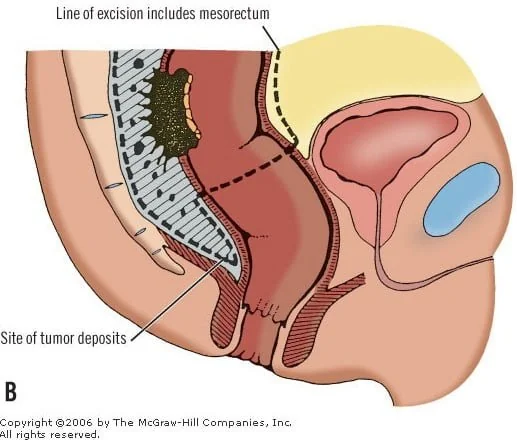
As can be seen from the above, the removal of a tumor in the rectum becomes more difficult the closer it is to the sphincter. The initial operation in these cases was an abdominoperineal resection where the surgeon removed the rectum along with the sphincter. It was self-evident that since the sphincter was removed, a permanent colostomy (pouch) had to be created in the abdomen from which the faeces would be expelled.
In the event that the rectal cancer is located near the sphincter, middle and lower part of the rectum, which means below 7-8cm from the ring, we should look for a specialized colorectal surgeon. The colorectal surgeon can operate on these tumors while preserving the sphincter so that the patient does not lose normal function.
This operation is called a low anterior resection and is accompanied by a transsphincteric or intersphincteric resection of the rectum (when the distance is less than 3cm from the sphincter or 5cm from the ring), and it can be performed even in tumors 1 cm from the sphincter. With these methods the patient can avoid a permanent colostomy.
The transsphincteric resection in rectal cancer is done when the tumor is too close to the sphincter (1-2cm) so that it is not possible to remove it without including part of the internal sphincter. The restoration of the anatomy of the anus is done by suturing with absorbable sutures the healthy intestine over the remaining external sphincter.
The myth that the rectal cancer patient ends up with a permanent colostomy (pouch) is no longer valid and it is important to know this. The only absolute indication for removing the sphincter is when it is also affected by the tumor, otherwise even 1 cm distance from the tumor to the sphincter is safe to perform an excellent oncological operation.
The current trend internationally is to reduce the number of mutilation operations to create a permanent colostomy (colostomy or bag), which should only be done in some cases such as when the sphincter is affected by cancer or when there is a severe incontinence problem. It is proven that these operations achieve the same or better treatment rates compared to abdominoperineal resection with permanent colostomy.
All of the above for the treatment of rectal cancer are thoroughly analyzed in the guidelines of international oncology organizations abroad such as the American NCCN www.nccn.org.
Rectal Cancer Survival Rates
Each case is unique and the percentages are simply an approximation. New treatments are discovered every day such as immunotherapy which greatly increases survival rates. In general, colon and rectal cancer is among the most curable and treatable. I am just listing some percentages for information.
- Rectal cancer average 5-year survival rate 68%.
- If the cancer is diagnosed at an early localized stage the survival rate is 90%.
- If it has spread to the lymph nodes it is 74%.
- If it has metastases the 5-year survival rate is 17%. However, if the metastases are few and operable, the removal of these tumors can eliminate the cancer, which significantly improves the survival rate.

Rectal cancer treatment with Laparoscopic or Robotic surgery.
The role of laparoscopic and classic surgery in the treatment of bowel and especially rectal cancer is one of the most debated issues and now robotic surgery is being added.
Although laparoscopic and robotic surgery have benefits and specific indications, they cannot always replace classical surgery. Classical surgery is the gold standard in the treatment of rectal cancer, with the culmination of difficult and advanced cases that cannot be treated laparoscopically or robotically.
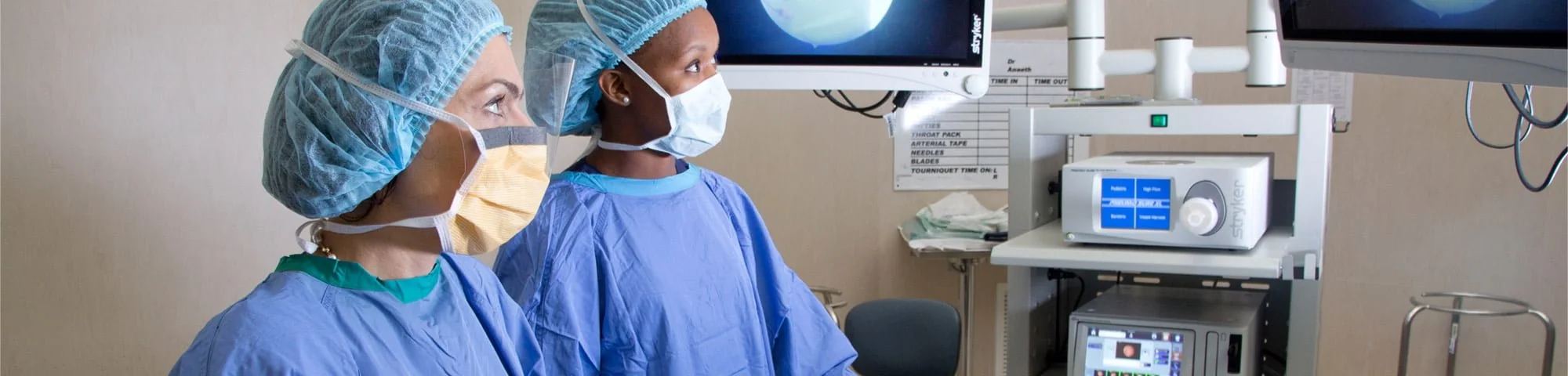
Laparoscopic surgery is preferred in benign conditions and small tumors that do not pose a risk of spread. And robotic surgery is still under study, however, it could be used everywhere and laparoscopic since it is a variant of it.
Conclusions on rectal cancer.
Therefore, we must choose our surgeon based on his expertise and experience. The specialized surgeon will suggest a method that has an indication for our case. Especially for tumors that are 1-3cm from the sphincter, transsphincteric excision is the method that will save us from the permanent permanent colostomy (pouch).
In rectal tumors that are very early stage T1 with low aggression has an indication and the method TEM – TAMIS which is done from the anus without an incision and with minimal side effects, while for very early-stage tumors in other parts of the intestine the method is indicated ESD.

Presentation of a new method without a natural basis in rectal cancer.
Up until now we have been talking about avoiding a permanent, permanent colostomy in rectal cancer. A temporary stoma* (ileostomy or colostomy) is usually made for 2-6 months until the anastomosis to the bowel heals. Then with a second operation the temporary bag is removed.
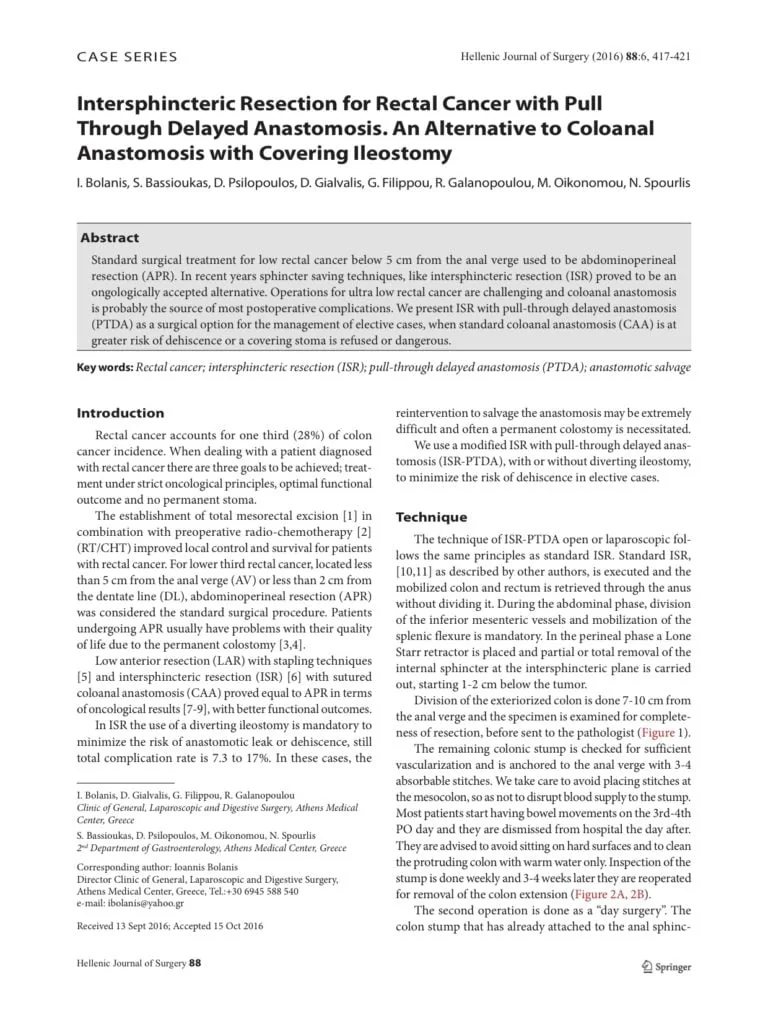
The following article describes her new technique transsphincteric resection with pull-through delayed anastomosis which also avoids temporary colostomy. The method was published in the Hellenic Journal of Surgery 2016 and was presented for the first time in Greece at the conference of the Athens Medical Center held at the Concert Hall on September 23-25, 2016. This technique has many advantages for the patient because it avoids both the permanent and temporary colostomy of rectal cancer. You can watch them all speeches here.
Rectal Cancer Frequently Asked Questions
Can permanent colostomy be avoided in rectal cancer?
Yes, with modern sphincter salvage techniques (such as the ISR intersphincteric resection and Dr. I. Bolani's pioneering ISR-PTDA method), a permanent colostomy can be avoided even in tumors very low in the rectum, only 1 cm from the sphincter.
What are the main symptoms of rectal cancer?
The most common symptoms are the presence of blood or mucus in the stool, a change in bowel habits (constipation-diarrhea alternation), the feeling of incomplete emptying (tenesmus), thinning of the stool, anemia and unexplained weight loss.
Is preoperative radiation and chemotherapy necessary?
In locally advanced tumors (Stage II and III), preoperative chemoradiation shrinks the tumor, drastically reduces the chance of local recurrence, and dramatically increases the chances of successfully retaining the sphincter without a colostomy.
How is the operation performed (Laparoscopic & Open Surgery)?
The operation is performed with a minimally invasive laparoscopic or open technique of total mesorectal excision (TME), offering absolute oncological precision, protection of the pelvic nerves to preserve urination and sexual function, minimal pain and rapid recovery.
What are the survival rates for rectal cancer?
In the initial stages (Stage I), the 5-year survival exceeds 90-95%. Even in advanced stages, the combination of modern oncological treatment and thorough radical resection by a specialized surgeon offers excellent long-term cure rates.
*Messphincteric or transsphincteric resection = Intersphincteric resection