
Crohn's Disease
What is Crohn's Disease?
Crohn's disease is an inflammatory disease that can affect any part of the digestive system. Its most frequent localization is in the small and large intestine. It is not contagious, nor is it a form of cancer. It is an inflammatory reaction of the body that gradually destroys some parts of the intestine. To date, no definitive treatment has been found for the disease, but medication and sometimes surgery can relieve the symptoms.
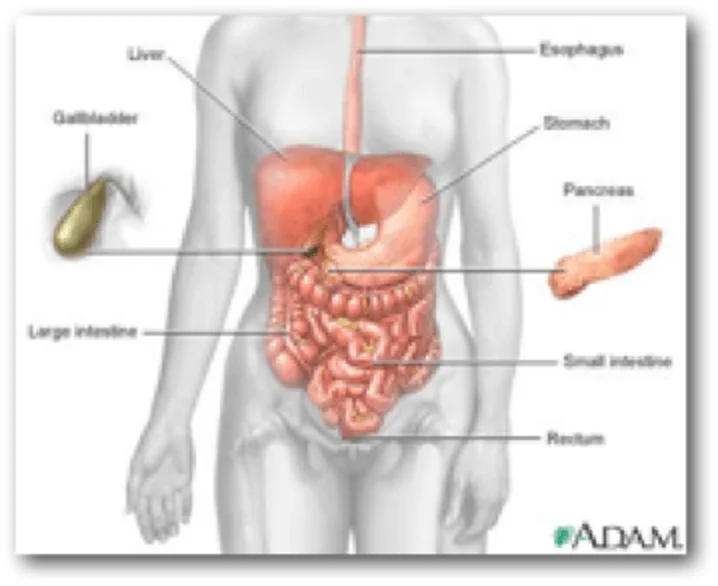
How is the digestive system affected by Crohn's disease?
Crohn's disease is a persistent inflammation due to which the walls of one or more parts of the digestive system become swollen and thickened. Thickening of the bowel wall can lead to stricture. Any part of the digestive system, from the mouth to the anus, can be affected. The part most often affected is the terminal ileum (the lower end of the small intestine), but Crohn's can also affect the colon (large intestine), or both at the same time. The area of the anus can also be affected, causing anal fissures, fistulas and abscesses.
What is the treatment for Crohn's disease?
The treatment of the disease is mainly medicinal. There are a multitude of formulations and there is constant research into the development of new drugs. Until now, however, no definitive treatment has been found, but we have succeeded in keeping the disease in remission and slowing down its recurrences. At some point in the course of the disease, the drugs will not be able to improve the patient's condition. Then the intervention of a specialized surgeon is needed to deal with the stenosis, fistulas, abscesses or any other complication caused by the disease.
Surgical treatment of Crohn's should be the last option in treatment and only if there is an absolute indication.
The reasons that will lead a patient to the surgery follow some general rules, but at the same time the indications are individualized for each case, for example the finding of dysplasia (pre-cancerous condition) in a young patient is of different importance compared to an elderly one.
So when should we consider surgical treatment?
Operations for Crohn's disease.
Surgery is usually recommended when symptoms cannot be satisfactorily controlled by other means. When the operation will be done depends partly on the patient, e.g. He no longer tolerates the symptoms. The operation usually involves removing the most affected part of the intestine and reattaching the remaining healthy intestine. Sometimes it may be necessary to remove the entire colon (large intestine) and create a stoma (abnormal seat).
The most common ones are described in more detail below operations.
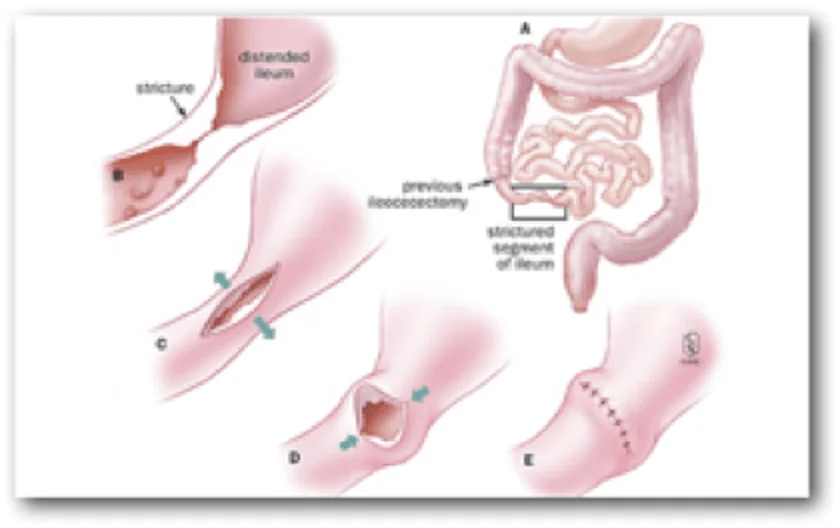
1) Stenoplasty
This operation is performed when there are small sections of the small intestine with stricture without serious other pathology eg fistula. The surgeon widens the intestinal tract at the points of strictures by cutting the stricture lengthwise and suturing it crosswise. This can relieve symptoms of obstruction without removing a section of bowel.
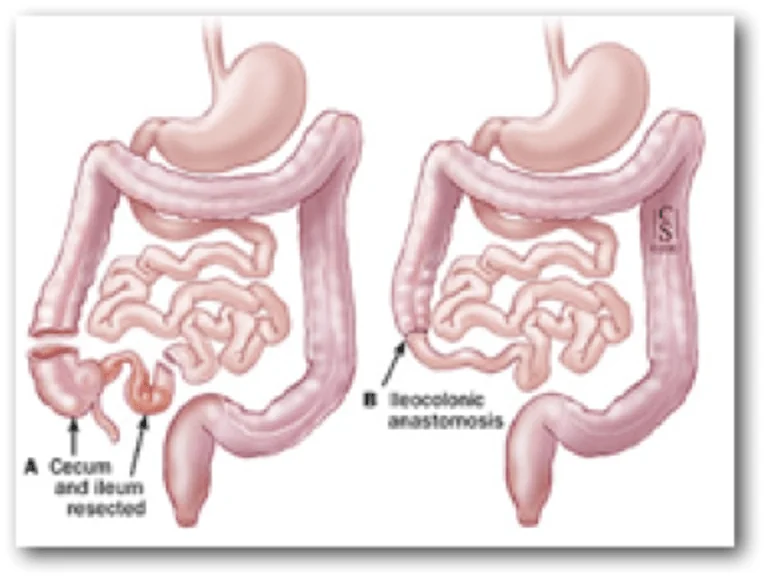
2) Excision
It involves removing the parts of the intestine that show severe changes and joining the healthy parts together. This operation helps patients whose symptoms of obstruction do not go away with medication or who present other complications such as fever, malnutrition, diarrheal syndrome, abdominal pain, etc. Also someone with a fistula that joins the affected intestine to the skin (enterocutaneous fistula), or that joins an internal organ e.g. The bladder (enterocystic) or another part of the bowel (enterointestinal) may be helped by an operation to remove the part showing the abnormality.
3) Proctocolectomy and Ileostomy
In this operation, the surgeon removes the entire large intestine, the rectum and the anus. The end of the small intestine protrudes into the abdominal wall creating a permanent opening (ileostomy). A bag is placed over the opening into which the waste of the small intestine ends. The bag is emptied or replaced when necessary.
Another procedure, the "lekython operation", which is often performed on patients with Ulcerative Colitis or Familial Polyposis to avoid a permanent stoma when the entire colon is to be removed, is not indicated for patients with Crohn's Disease. This is because Crohn's can also occur in the small intestine, unlike Ulcerative Colitis. If Crohn's develops in the ileum and does not respond to medication, removing the ileum involves removing a significant portion of the small intestine.
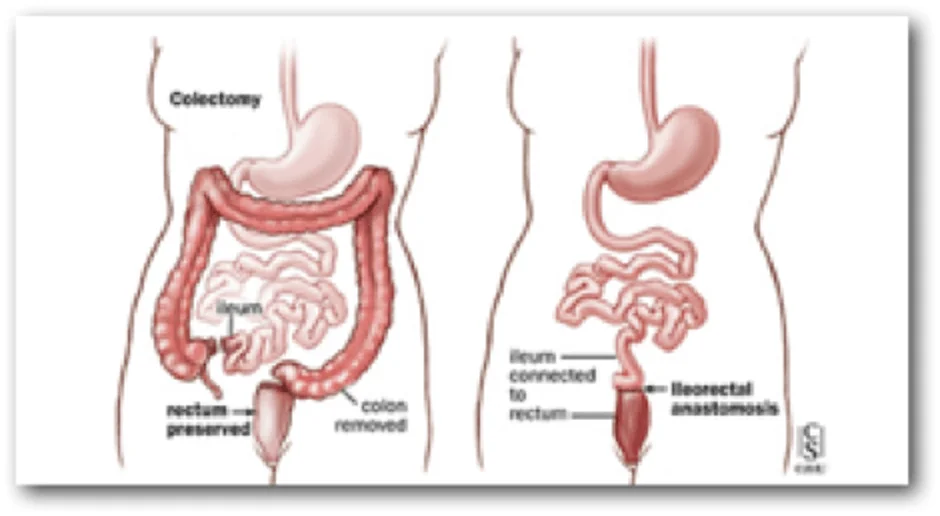
4) Ileorectal Anastomosis
In some cases, even when the entire colon needs to be removed, it may be possible to join the ileum (the lower end of the small intestine) to the upper end of the rectum. This is called an ileorectal anastomosis. This is possible because the rectum is often not affected by Crohn's disease even when the colon is severely affected. This operation is not indicated when there is severe inflammation or ulceration in the rectum, or when the rectal muscles have suffered some damage, because the control of bowel movements becomes more difficult.
5) Partial Colectomy
If only the lower part of the large intestine is affected and the upper part can remain, then it is possible to create a stoma from the healthy large intestine (colostomy) usually in the lower left part of the abdomen.
6) Temporary stoma: Ileostomy or colostomy
Sometimes a temporary ileostomy and colostomy is performed to divert intestinal waste and give the intestine a chance to heal. During the operation, the ileum (the lower end of the small intestine) or the colon (the large intestine) protrude into the abdominal wall and create a stoma that empties the contents of the intestine into a bag. Once the colon (large intestine) has recovered satisfactorily, the stoma will be closed in a second operation.
Balance between interventions and other treatments.
An operation is performed to remove a diseased or narrowed part of the intestine. However, in Crohn's disease, other parts of the intestine may also be affected later and another operation may be considered necessary. If a patient is operated on repeatedly, a significant portion of the intestine may be removed. In some cases this can lead to diarrhea and nutritional problems that are not due to Crohn's, but to the lack of sufficient length of healthy intestine to allow adequate absorption of nutrients from food.
The surgeon tries to achieve a balance between the advantages and possible problems of surgical treatment, so it is important to have the experience of when the patient should be taken to the operating room and what is the most suitable operation for his case. Unfortunately, it is a common phenomenon that these operations are performed by non-specialists and that a larger part of the intestine is removed from the patient or that a poor choice of operation and treatment is made.
On the other hand, we should not exaggerate the drug treatment when there is no response to it so as not to exhaust the patient. A weakened physically ill person cannot easily cope with an operation and as a result the complications are more serious and dangerous.
I would therefore recommend that when the condition starts to get out of the control of medication, there should be collaboration and consultation of the Gastroenterologist with a specialist Surgeon to maintain the balance for the best possible treatment of the disease.
The Association of People with Crohn's Disease and Ulcerative Colitis of Attica and Northern Greece can offer practical advice and support to people with Crohn's disease. Read the book.