
Colorectal cancer, diagnosis, treatment, prognosis.
Colorectal cancer, how is it diagnosed, treated and what is the prognosis. We will refer to the most important secrets of colon cancer surgery, while the final part of the colon Straight we will analyze it separately because it has several peculiarities.
Bowel cancer is the third most common cause of cancer death worldwide. It is helpful if not essential for patients to know some important information regarding colon cancer. The increased incidence of bowel cancer is due to the polyps of the colon are quite common and a large percentage of them will develop into colon cancer.

Colorectal cancer general facts and anatomy.
The large intestine (colon) is the last part of the gastrointestinal system and is responsible for absorbing mainly water and electrolytes. There is the formation of feces which will then be expelled. The length of the large intestine is about 1.5 meters. Its final part, which is about 15 centimeters long, is the rectum. The rectum is essentially the storage area of the large intestine and has a capacity of 0.6-1.2 liters. The main role of the rectum is to expel faeces (defecation).
Colon polyps and the relationship to bowel cancer.
The colon polyps they increase in frequency with increasing age and are the early benign stage before colon cancer. One third of the population over 50 has a polyp, and this percentage increases to 50% after the age of 70. As it has been proven, adenomatous polyps are the ones that will develop into malignancy.
The transformation of a polyp into a malignant one takes place at a fairly slow rate, so with the colonoscopy we manage to discover it in time and remove it. It takes 5-10 years for a polyp to develop into bowel cancer, therefore by doing the first colonoscopy at the age of 50 and repeating it every 5 years we prevent the disease and avoid the need for surgery.
The size of the bowel polyp, its morphology and composition influence the likelihood of developing malignancy. The polyps which are smaller than 1 cm rarely hide malignancy (1.5%), while above 2 cm the rate of malignancy reaches almost 50%. When a polyp is found during the colonoscopy, it should be removed and sent for a biopsy. As long as there is no malignancy in the biopsy and the removal is complete no further treatment is needed.
Bowel polyp treatment.
In the case of malignancy, a referral for surgical evaluation and treatment is recommended, while sometimes the gastroenterologist needs to mark with a special dye the location of the polyp so that the surgeon can locate it during the operation. An attempt should be made to remove the intestinal polyp whole and not in pieces.
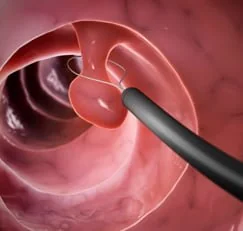
A good gastroenterologist can remove the majority of small polyps and very few cases will end up in surgery. The patient is referred to the surgeon when the polyp cannot be removed endoscopically due to size, risk of bleeding or perforation, difficult position, or other technical reasons, or because the biopsy shows high-grade dysplasia that is a precancerous condition or malignancy.
Colorectal cancer.
Colorectal cancer is the 3rd Most common malignancy in women after lung and breast and similarly in men after lung and prostate. The usual age of its appearance is after 50 years and for this reason it is recommended that the first colonoscopy be done at this age and if it is normal to be repeated every 5 years.
In recent years, unfortunately, the incidence of colon cancer has increased at younger ages, so according to the American Cancer Society, colonoscopy should start at the age of 45 and is expected to decrease even more in the coming years.
An exception to the above rule are hereditary forms that appear at younger ages, in which case colonoscopy is recommended for immediate relatives at least 10 years earlier. For example, if a parent develops colon cancer at the age of 40, their children should be screened with a colonoscopy before the age of 30.
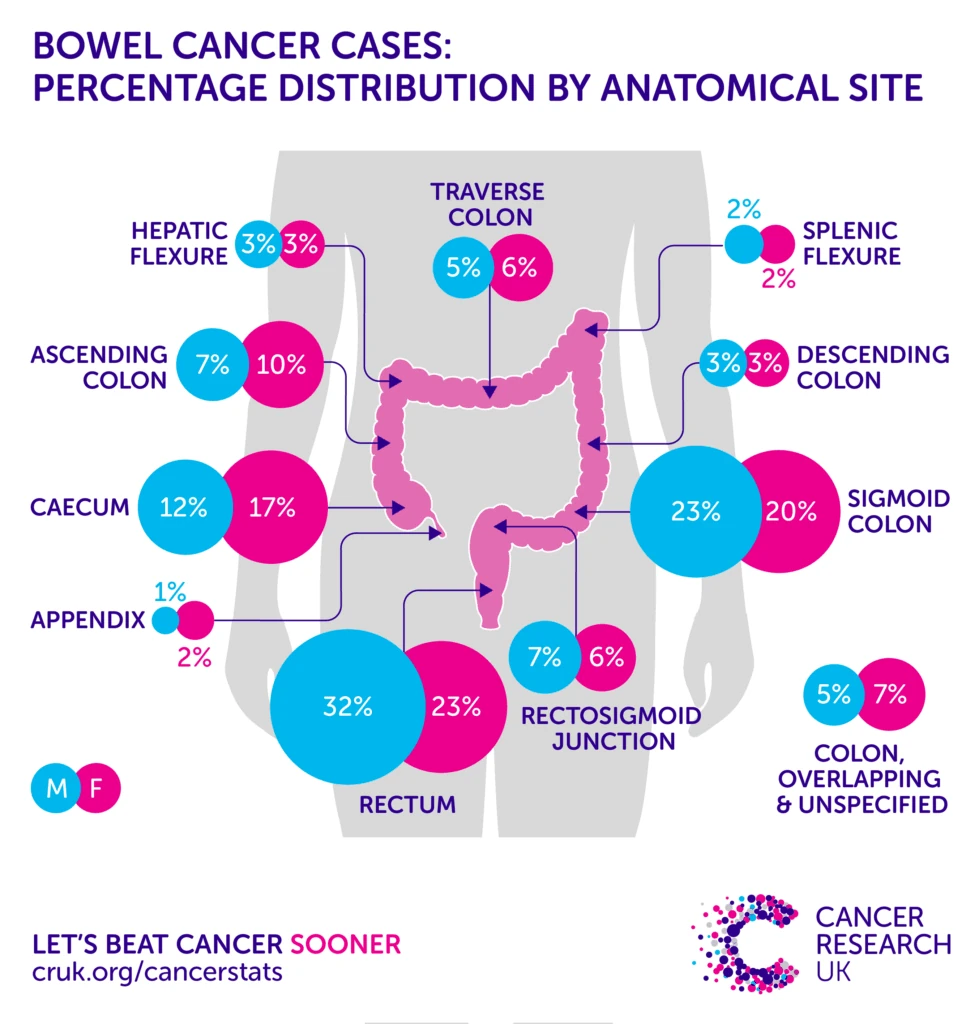
Half of the cases of bowel cancer are located in the rectum and sigmoid, they are the final sections of the large intestine where the feces remain before being expelled and are therefore more exposed to the body's toxic waste.
Colon cancer has a good prognosis if treated early and correctly. Its treatment includes the correct oncological operation combined with chemotherapy when the tumor escapes the boundaries of the intestine either in the form of local extension or in the form of lymph node metastases. The inclusion of the patient in the appropriate oncological protocol is a decision of the multidisciplinary team which usually consists of the surgeon, the oncologist, the radiologist and the pathologist.
The "secrets" of the surgical treatment of colon cancer.
Changing the future and prognosis in bowel cancer.
We will talk about it separately Straight from the large intestine because there are some important differences. The rectum, due to its proximity to the sphincter responsible for controlling bowel movements and the particular anatomical structures that surround it (prostate, vagina, bladder, vessels and nerves) requires a different therapeutic approach. Often in rectal cancer the issue of radiation and permanent colostomy (pouch) which significantly complicate the work of the surgeon, so there he needs specialized colorectal surgeons. The specialist colorectal surgeon can achieve better results than the non-specialist in both colon and rectal cancer.
The large intestine (colon) is located inside the abdomen and is suspended by a "membrane" of fat called the mesocolon which contains the fat, blood vessels (arteries and veins), nerves and lymph nodes of the large intestine. Lymph nodes are tiny glands responsible for the body's defense both against microbes and against cancer cells, and are the first site of detection of metastases.
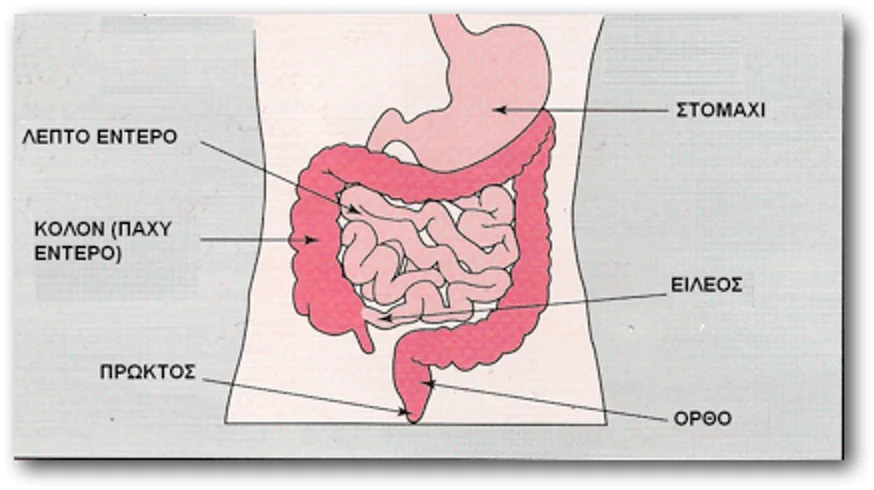
The large intestine is divided into sections according to its location and each of them corresponds to a specific area in the mesocolon. The segments of the colon are the cecum (includes the appendix), ascending (right), transverse, descending (left), and sigmoid. This anatomy is of great importance in bowel cancer surgery because when we remove the part of the colon that has the tumor, the section based on the classification we mentioned must be removed as a whole, together with the entire corresponding section of the mesocolon to ensure a proper oncological cleaning.
Oncological surgery in bowel cancer.
Therefore, an oncological operation in the intestine differs from any other intestinal operation, because the entire diseased part must be removed together with its lymph nodes and vessels, regardless of whether the tumor occupies only a very small part.
Confirmation that the operation follows oncological rules comes from the biopsy of the removed colon. The rules are summarized below:
1) Colon resection margins should be healthy (clean) and at least 5 cm away from the tumor (except the rectum where the limit is 1 cm).
2) The lymph nodes removed together with the bowel must be at least 12. This number of lymph nodes is considered necessary to be able to stage bowel cancer.
3) There should be no residual tumor left in the patient (R0 resection).
With these rules we can assess the quality of the operation. Oncological surgery ensures the maximum survival to the patient and helps to achieve the best result from chemotherapy. Detailed information on the treatment of bowel cancer can be found on its page NCCN.
Colorectal cancer incidence.
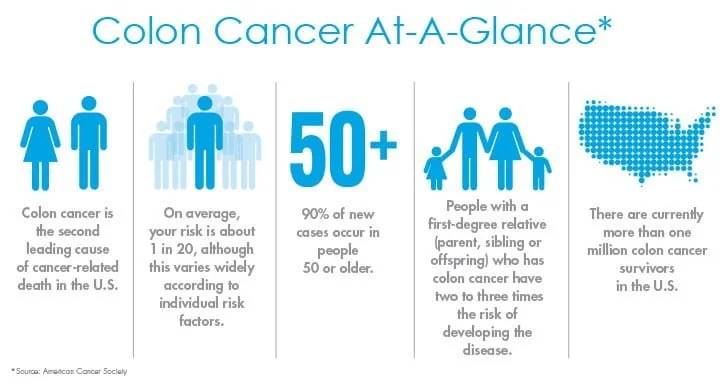
Colorectal cancer is the third most common cancer in men and women. The chance of developing bowel cancer in our lifetime is about 5%.
90% Of new cases of bowel cancer occur in people over the age of 50. Those who have first-degree relatives with bowel cancer have twice the risk of developing the disease.
Regarding the distribution of colon cancer, almost half of the tumors are located in the terminal part of the intestine, i.e. In the sigmoid and the rectum.
Based on the most recent data, the incidence of bowel cancer is expected to increase in young people under the age of 50 in the coming years. This increase is estimated at 124% among 20-34 year olds by 2030 according to the latest statistics. Already in several states it is recommended to start colonoscopy from the age of 45 and it will probably decrease even more in the coming years.
Colon Cancer Survival
Each case is unique and the numbers are indicative. New treatments such as immunotherapy greatly increase survival rates. In general, colon and rectal cancer is among the most curable and treatable.
Colon cancer average 5-year survival rate 63%.
If the cancer is diagnosed at an early localized stage the survival rate is 91%.
If it has spread to the lymph nodes it is 72%.
If it has metastases the 5-year survival rate is 13%. However, if the metastases are operable, removing these tumors can eliminate the cancer, which greatly improves the survival rate.
Colorectal cancer predisposing factors.
Factors that can increase the predisposition to colon cancer are the following:
- Age: Most patients are over 50 years old
- Personal history: If there is already a history of polyps or bowel cancer
- Inflammatory bowel disease: A history of ulcerative colitis or Crohn's disease increases the chance of bowel cancer
- Hereditary syndromes of intestinal polyposis
- Family history of colon cancer
- Diet rich in fat and low in fiber
- Sedentary life
- Diabetes mellitus
- Obesity
- Smoking
- Alcohol
- Irradiation
Hereditary forms of bowel cancer.
The most common hereditary forms of colon cancer are Lynch syndrome HNPCC (Hereditary nonpolyposis colorectal cancer) and FAP (Familial adenomatous polyposis).
- Lynch syndrome HNPCC (Hereditary nonpolyposis colorectal cancer) accounts for 3% of colon cancers. These patients have an 80% incidence of colon cancer, 2/3 of the tumors arise in the right colon and usually appear before the age of 50. The probability of inheriting it to their children reaches 50%. They are also predisposed to develop cancer of the endometrium, ovaries, stomach, small intestine, liver, etc. To identify a patient candidate for Lynch syndrome, the following Amsterdam criteria and Bethesda Guidelines have been developed.
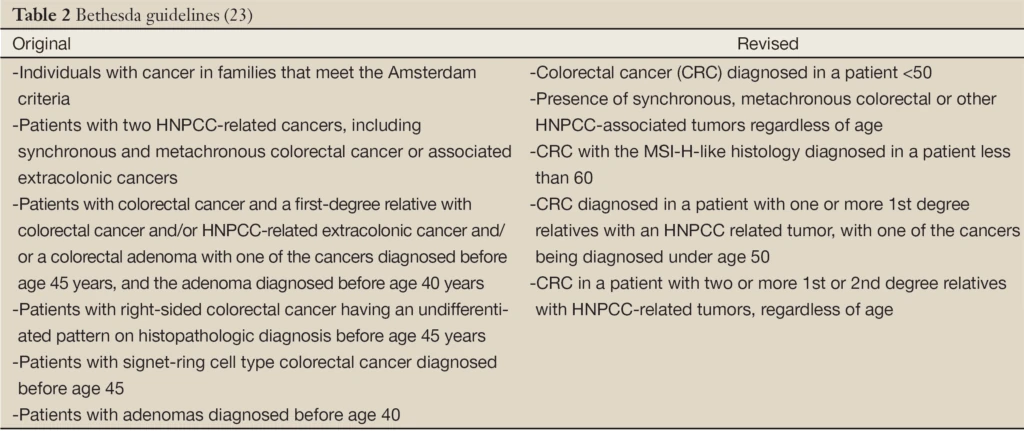
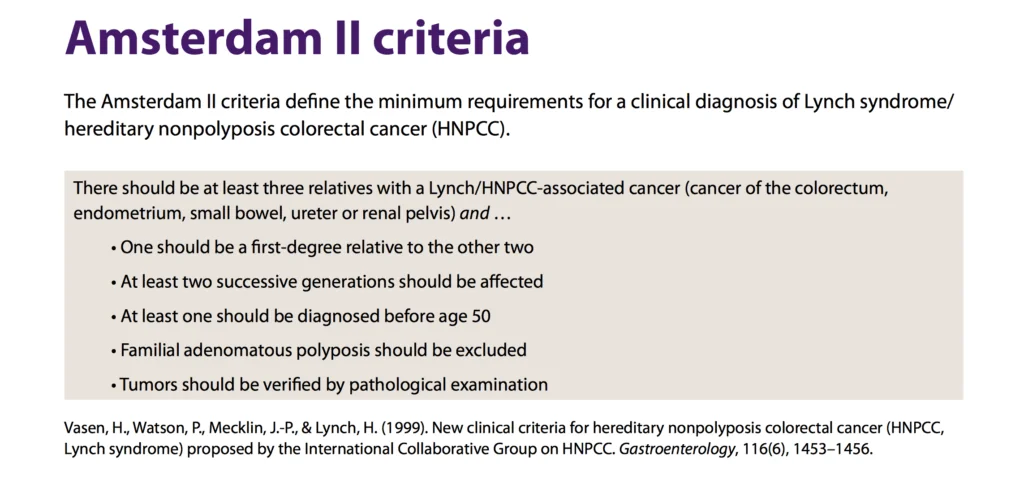
- Familial adenomatous polyposis (FAP) accounts for 1% of bowel cancers. These patients usually present with colon cancer at a much younger age <40 years. Their intestines have hundreds of polyps. The chance of bowel cancer is 100%. The probability of inheriting it to their children reaches 50%.
Colon cancer symptoms.
The following symptoms should concern us and lead us to visit either a gastroenterologist or a surgeon specialized in the intestine.
- Change in bowel habits lasting more than four weeks. This can be diarrhea or constipation or a change in stool consistency.
- Blood in the stool or bleeding.
- Abdominal pain, malaise, flatulence.
- Feeling of incomplete bowel emptying.
- Weakness and easy fatigue.
- Unexplained weight loss.
Often most patients do not have symptoms in the early stages therefore preventive colonoscopy after 50 is the best method for prevention.
Complications of colon cancer.
Complications of colon cancer can be obstruction (ileus), bleeding and perforation. When complications appear, surgery is usually performed immediately and they are a contraindication for laparoscopic surgery.
- Symptoms of ileus include pain, bloating, vomiting and inability to pass gas or stool.
- Bleeding usually occurs with multiple diarrheal stools that are foul-smelling and red or purple in color.
- The perforation has the symptoms of peritonitis with severe abdominal pain and fever.
Staging of the disease and its importance.
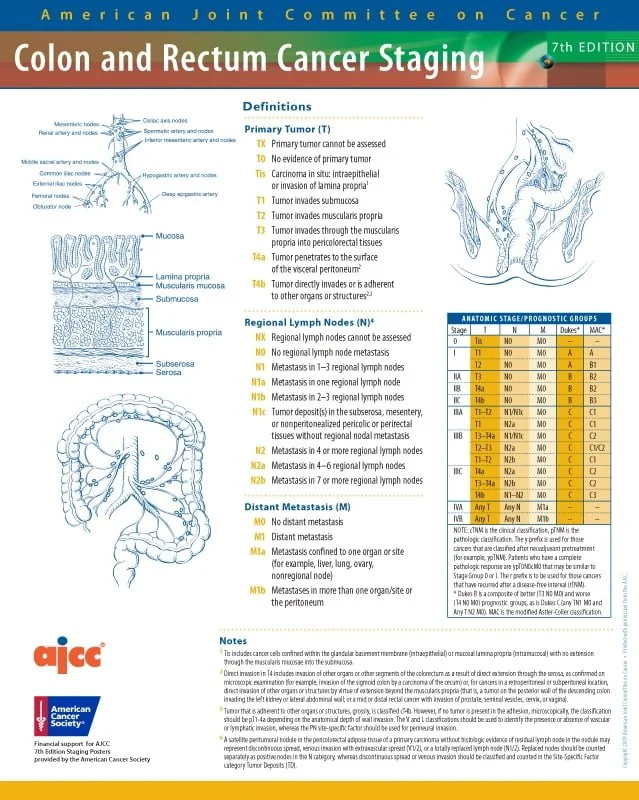
Bowel cancer staging is essential to plan appropriate treatment, predict disease progression, and monitor the effectiveness of therapeutic interventions.
Staging is done with CT scans of the upper abdomen and chest which will show us the extent of the disease. Depending on the findings of the CT scan, other more specific tests may be needed, such as magnetic resonance imaging and PET scan, which are usually used when metastases or recurrence are suspected.
Final tumor and lymph node staging is done after surgery by histological examination of the removed bowel. The stage of the tumor after surgery will also determine the need for chemotherapy which is necessary when the tumor is outside the bowel or there are lymph nodes involved.
Laparoscopic and robotic surgery in colon cancer.
The role of laparoscopic and conventional surgery in the treatment of bowel cancer is one of the most debated issues, and now robotic surgery is being added.
Laparoscopic and robotic surgery, although they have benefits and specific indications, cannot replace classical surgery, which is the gold standard in the treatment of bowel cancer, culminating in difficult and advanced cases that cannot be treated laparoscopically or robotically.
Laparoscopic surgery is preferred in benign conditions and small tumors that do not pose a risk of spread. And robotic surgery is still under study, however, it could be used everywhere and laparoscopic since it is a variant of it.
Conclusions.
- The treatment of colon cancer is achieved with the correct surgical intervention following all the oncological rules.
- Colectomy as the operation is called must include the part of the intestine containing the tumor and all the corresponding lymph nodes based on anatomical and oncological criteria.
- Today there are specialized colorectal surgeons who can ensure a good surgical result.
- Bowel cancer survival rates are high when treated properly.
- Prevention is the best way to avoid colon cancer and it is done with a colonoscopy.
- The colonoscopy must be performed by an experienced gastroenterologist and must be complete.
- The starting age for colonoscopy is 50 years unless there are symptoms or heredity in which case it should be done earlier.
- In the coming years, the threshold for starting colonoscopies is expected to decrease as cancer in the under-50s increases.
- A healthy lifestyle reduces the chance of bowel cancer.
- Colorectal cancer is one of the most curable cancers if treated correctly and early.
- Colon cancer does not cause symptoms in the initial stages, so prevention is the best treatment.
- Any change in bowel function that persists for more than a week should be checked, whether it's constipation or diarrhea that persists for no apparent reason.
- Also, a bowel check should be done when there is anemia, blood or mucus in the stool or other symptoms from the abdomen.
The most important difference in Rectal cancer relative to the rest of the intestine is that it is near the sphincter. Because of this we often hear the term permanent colostomy (colostomy) for rectal cancer, but where we can avoid it with new methods.